Am 1. November 2023 eröffnete Marktlink das Office in den britischen Midlands, um die Regionen Birmingham und Nottingham bei M&A-Anliegen zu beraten. Die Niederlassung ist die 13. im internationalen Netzwerk und, nach Manchester im letzten Jahr, die zweite im Vereinigten Königreich.
Trotz der vergangenen wirtschaftlichen Herausforderungen am britischen Markt, sind die Unternehmer und Unternehmerinnen voller Zuversicht. Unsere Marktanalyse hat gezeigt, dass die britischen Unternehmer und Unternehmerinnen optimistisch in die Zukunft blicken.
Die Leitung des Midland-Offices wurde dem frischernannten Partner Joe Moran übertragen. Joe bringt 17 Jahre Erfahrung in der Unternehmensfinanzierung mit und berät Unternehmen bei ihren Akquisitions- und Veräußerungsstrategien. Davor war er bei Deloitte, Jaguar Land Rover und Rolls-Royce tätig. „Das Vereinigte Königreich ist ein großer und etablierter M&A-Markt, und ich freue mich sehr, die nächste Phase der erfolgreichen internationalen Expansion von Marktlink zu leiten und Unternehmer und Unternehmerinnen in dieser bedeutenden Geschäftsregion an ihre M&A-Ziele zu bringen.
Der Kauf oder Verkauf eines Unternehmens ist eines der wichtigsten Ereignisse im Leben eines Unternehmers. Mit der Eröffnung des neuen Büros haben Inhaber und Inhaberinnen in den Midlands Zugang zu unserer M&A-Expertise und unserem umfassenden Netzwerk europäischer Investitionsmöglichkeiten. Damit können sie die Zukunft für ihr Unternehmen optimal absichern.”
Luc Keltjens, Partner bei Marktlink Amsterdam, hat intensiv an der Expansion im Vereinigten Königreich mitgewirkt. „Wir waren seit der letztjährigen Eröffnung unseres ersten Offices im Vereinigten Königreich sehr erfolgreich. Die Nachfrage seitens europäischer Unternehmen, hier zu kaufen, wächst beständig. Unternehmer und Unternehmerinnen in den Midlands, und darüber hinaus, können jetzt unser internationales Netzwerk aus 50 Deal-Teams in sechs Ländern nutzen, um von der wachsenden Nachfrage nach grenzüberschreitenden Optionen zu profitieren.
Joe hat viel Erfahrung und Expertise, wie er die Unternehmer und Unternehmerinnen der Region am besten unterstützen kann, daher sind wir zuversichtlich, dass er den Wettbewerbsvorteil der Unternehmen der Midlands bestens voranbringt. Wir freuen uns darauf, unsere Erfolgsgeschichte fortzusetzen und unsere Position am UK-Markt zu stärken.“
Jonny Parkinson, seit 2022 Partner in Manchester, stellt fest, dass britische Unternehmen die schlimmsten wirtschaftlichen Herausforderungen hinter sich haben. Er betont, wie wichtig es ist, nach vorne zu schauen und Wachstumsstrategien für Unternehmen zu planen, besonders, wenn es um Nachfolgeregelungen geht. „Im Vereinigten Königreich war die Talsohle tiefer als in anderen europäischen Ländern – mit Herausforderungen wie Schuldenmärkte, Zinsobergrenzen und die Nachwirkungen des Brexits. Nichtsdestotrotz schauen die Unternehmer und Unternehmerinnen im britischen KMU-Segment voller Hoffnung ins nächste Jahr. Unsere Marktstudie zeigt, dass 57% der Unternehmer und Unternehmerinnen erwarten, dass der inländische M&A-Markt im nächsten Jahr zulegen wird, im Vergleich liegt der Durchschnitt in Europa bei 48%. Darüber hinaus eröffnen wir den britischen KMU jetzt unser weitreichendes europäisches Netzwerk. Das kann das Wachstum und die Ziele der britischen Unternehmer und Unternehmerinnen positiv beeinflussen. Wir sind bereit, sie bei der Umsetzung ihrer Wachstums- und Akquisitionspläne im Vereinigten Königreich zu unterstützen.“
“M&A is not going to get easier in 2027, but there will still be good deals being done, with good multiples for good businesses.”- Victoria Ansell, Managing Partner, Marktlink London
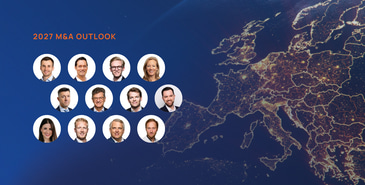
The overall sentiment for 2027 is cautiously optimistic. More businesses may come to market and investors remain ready to deploy capital, but buyers are expected to stay disciplined. That distinction between a stronger market and an easier market runs throughout the predictions. In Zagreb, Managing Partner Dino Bendeković expects preparation to make the difference:
“In this region, good companies will get deals done, but truly prepared companies will achieve the best terms.”
For business owners, preparation therefore becomes much more than getting ready for due diligence. Strong reporting, documentation, management and systems can influence how buyers perceive risk and ultimately the valuation and deal terms they are prepared to offer.
The same combination of opportunity and selectivity emerges in Switzerland. Jelmer Duijve and Marc Reinhardt expect the Swiss SME M&A market to remain strong, with continued macroeconomic uncertainty potentially encouraging some business owners to consider an earlier or partial exit. At the same time, buyers are becoming increasingly selective.
Succession and PE could unlock the next wave of deals
Some of the strongest reasons for businesses to enter the market have little to do with short term economic conditions. Across Europe, an ageing generation of owners is approaching decisions about succession, often without an obvious family or management successor.
The European Commission warned in June 2026 that this demographic challenge could affect millions of businesses across the EU over the next decade. Thomas Kästele, Managing Partner at Marktlink Hamburg, expects this challenge to become increasingly visible:
“In 2027 the need for succession of so many family-owned companies all over Europe will become the most pressing issue.”
Irene Martin, Director at Marktlink Madrid, sees the same pressure among family-owned businesses in Spain. But she also expects a broader shift in the purpose of transactions:
“M&A will increasingly become a strategic tool for building resilience, competitiveness and scale, rather than simply accelerating growth.”
For some companies, a transaction could bring the technology, talent, supply-chain strength or access to new markets they need to compete. That does not always require an outright sale. Irene expects more minority investments, partial exits and partnerships as buyers and sellers look for ways to share risk and bridge differences in valuation.
Private equity may add to the flow of opportunities. Companies nearing the end of extended investment holding periods could return to the market, creating scope for exits and secondary buyouts alongside succession-driven transactions.
If succession creates more reasons to sell, international consolidation could widen the pool of potential buyers. Pierre-Alexandre Vray, Managing Partner at Marktlink Lyon, makes one of the boldest predictions of all:
“M&A will increasingly become a strategic tool for building resilience, competitiveness and scale, rather than simply accelerating growth.”- Irene Martin, Director, Marktlink Madrid
For some companies, a transaction could bring the technology, talent, supply-chain strength or access to new markets they need to compete. That does not always require an outright sale. Irene expects more minority investments, partial exits and partnerships as buyers and sellers look for ways to share risk and bridge differences in valuation.
Private equity may add to the flow of opportunities. Companies nearing the end of extended investment holding periods could return to the market, creating scope for exits and secondary buyouts alongside succession-driven transactions.
If succession creates more reasons to sell, international consolidation could widen the pool of potential buyers. Pierre-Alexandre Vray, Managing Partner at Marktlink Lyon, makes one of the boldest predictions of all:
“2027 will mark the end of domestic private equity in Europe. French funds buying only in France, Dutch funds only in the Netherlands, that model is over. Capital will chase the best mid-market assets wherever they sit, and cross-border deals will become the norm, not the exception.”- Pierre-Alexandre Vray, Managing Partner Marktlink Lyon
It is a striking forecast, rather than a certainty. But the logic behind it is clear: in sectors that have already consolidated nationally, building larger European platforms may be the next step. Pierre Alexandre Vray argues that businesses able to think beyond their domestic markets could have an advantage, while sellers may have access to a much deeper buyer pool than they expect.
The opportunity is tangible in fragmented industries. Jelmer Duijve and Marc Reinhardt identify accountancy and HVAC in Switzerland as potential areas for further consolidation. Irene Martin sees similar pressure across the European mid-market, where smaller companies need to invest in digitalisation, technology, talent and operational capabilities.
For founder-led businesses, this changes the conversation. A transaction may be less about stepping away and more about finding the partner needed to grow. Dino Bendeković describes companies that are strong local champions but have reached a point where greater scale, succession or international expansion requires outside support. And, as Jonny Parkinson notes, more international and strategic interest could create a broader, more competitive buyer universe for owners.
AI will change both the process and the price
Cross-border dealmaking is not the only development that could make the market move differently in 2027. AI is expected to change how advisers find opportunities, assess companies and prepare transactions, potentially at speed.
Stefan Eggers, Director at Marktlink Hamburg, expects the timeline for approaching investors to shrink dramatically:
“The time to market will further decrease. In the past, it usually took three months to approach investors. This will be done within weeks.”
Jonny Parkinson points to faster data analysis, market research, buyer identification and preparation of transaction materials. Irene Martin expects target screening, market mapping, financial analysis and due diligence to become not only faster but more comprehensive. Pierre Alexandre Vray believes the biggest shift could occur before due diligence even begins:
“Everyone talks about AI in due diligence, but the real shift is upstream: identifying the right targets and the right buyers, faster and across borders, before anyone else has made the call.”-
Yet AI is more than a tool for executing deals. It may increasingly influence which companies attract investment in the first place. Jelle Rutgers, Partner at Marktlink Rotterdam, points to this wider effect on the businesses buyers choose and how they value them. Irene Martin expects investors to pay closer attention to a company’s AI readiness, its vulnerability to disruption and its ability to use technology to improve productivity, margins and scalability.
In other words, AI could help find a buyer faster while also changing the questions buyers ask. Businesses that can demonstrate genuine resilience and a credible use of technology may stand out. Those more exposed to disruption may face closer scrutiny.
Despite these efficiencies, AI is not expected to replace the human fundamentals of M&A.
Victoria Ansell summarises it simply: “AI is a tool, not a panacea.”
And Pierre-Alexandre Vray captures the balance between technology and relationships particularly well: “AI won’t replace the handshake, it will decide who gets to shake hands first.”
That distinction is important. AI and data can unlock opportunities that might otherwise remain invisible. They can connect information across markets, identify potential buyers or targets, analyse large volumes of company data and highlight relationships or patterns that would be difficult to spot manually.
M&A is ultimately about bringing people together. Advisers still need to make the introduction, build trust between the parties and understand what motivates an entrepreneur or potential buyer. They need to break the ice when conversations are difficult, overcome resistance when interests diverge and find common ground during negotiations. Those moments require judgement, empathy, commercial sensitivity and an understanding of the people behind the numbers.
“AI can significantly improve and accelerate the analytical side of our profession, but trust between buyer and seller, commercial sensitivity and complex negotiations still rely on human expertise and judgement.”- Jeffrey Scholtens, Partner, Marktlink Deventer
Irene Martin reaches a similar conclusion:
“Ultimately, AI will not replace the judgement and experience of M&A professionals, but it will raise the standard of analysis and allow advisors to focus more time on strategic thinking, negotiation and value creation.”
For business owners, the outlook for 2027 is therefore promising, but not straightforward. Succession and consolidation could bring more businesses to market. International capital could bring more buyers to the table. AI could make those connections happen sooner — and raise the standards used to assess a company.
The opportunity will be real. Turning it into the right deal will still come down to preparation, positioning and the trust built between people.
Kontaktieren Sie uns gerne für weitere Informationen.